

A Certificate of Destruction Is the Minimum. Here’s What Audit-Ready Documentation Looks Like.
At the end of an ITAD project, most organizations receive a certificate of destruction and file it away. If an audit never comes, that’s the end of it.
But audits do come. Regulatory inquiries come. Data breach investigations come. And when they do, a single PDF with a date and a vendor signature is rarely sufficient to demonstrate that your organization met its data protection obligations — or that the vendor who handled your retired assets was operating to a standard that would hold up to scrutiny.
The documentation that matters for compliance isn’t what you receive at the end of the project. It’s what’s being built throughout — serialized, verifiable, and accessible before anyone asks for it.
Sanitization vs. Destruction: The Distinction That Determines Your Documentation
The first question that shapes your reporting is whether your assets were sanitized or destroyed — because the documentation requirements, and the appropriate choice between them, are meaningfully different.
Data sanitization is the process of overwriting data on a storage device to the point where it cannot be recovered, while leaving the device physically intact and functional. When sanitization is performed to NIST 800-88 standards — the federal framework that defines media sanitization requirements by device type — the device can be remarketed, donated, or redeployed. The NIST 800-88 standard specifies three levels of sanitization: Clear, Purge, and Destroy. For most enterprise storage media, Purge-level sanitization using verified overwrite or cryptographic erase meets the standard for devices that will be remarketed.
Data destruction is physical — shredding, crushing, or disintegrating the device so that the data-bearing components are rendered unreadable and the device is permanently non-functional. Hard drive shredding produces a verifiable, irrecoverable result documented at the individual device level.
The choice between them isn’t arbitrary. It depends on the classification of the data the device held, your organization’s internal data governance policy, the regulatory environment you operate in, and whether residual asset value matters to the disposition decision. Healthcare organizations governed by HIPAA, financial institutions under GLBA, and government contractors operating under federal data handling requirements each have specific obligations that should inform the sanitization-versus-destruction decision before a single device leaves your facility.
What both approaches share is a documentation requirement: serialized records tied to individual assets, specifying the method applied, the standard it was performed to, and the verified outcome. A report that says “100 drives were destroyed” is not the same as one that documents device-by-device disposition with serial numbers, asset tags, and verified results. The former satisfies a filing requirement. The latter withstands an investigation.
The Reports CompuCycle Provides — and Why Each One Matters
CompuCycle’s reporting is designed to give IT, security, and compliance stakeholders the documentation they need for their specific requirements — not a single generic certificate applied to every engagement regardless of scope.
Certificate of Data Destruction
The certificate of data destruction documents the completed disposition of your assets — what was processed, when, by whom, and to what standard. Ours are asset-level, meaning each device processed appears individually with its serial number, asset tag, and the specific destruction or sanitization method applied. This is the document your legal team needs if a device ever surfaces in a breach investigation, and it’s the document that demonstrates to an auditor that disposition was verified, not assumed.
Data Sanitization Reports
For assets processed under NIST 800-88 sanitization protocols rather than physical destruction, the sanitization report documents the overwrite passes completed, the verification result, and the NIST 800-88 level achieved per device. This level of specificity matters when your data governance policy requires documented proof of sanitization method, not just confirmation that a vendor performed some form of data wiping.
Asset Inventory and Chain of Custody Documentation
From the moment your assets are tagged and staged for pickup through final disposition, every step in the chain of custody is documented. The inventory report lists every device collected — by serial number, asset tag, make, model, and condition — creating an auditable record that ties your internal asset register to our disposition records. Discrepancies between what was collected and what was processed are flagged, not silently absorbed.
Downstream Disposition Reports
Where assets are remarketed rather than destroyed, downstream disposition documentation records what happened to each device after sanitization — whether it was refurbished for resale, donated, or processed for material recovery. For organizations with environmental reporting requirements or internal sustainability metrics, this documentation supports the data behind your e-waste diversion and circularity reporting.
The Client Portal: Your Documentation, When You Need It
Compliance documentation doesn’t help anyone if it’s buried in an email thread or stored in a folder only your vendor can access. CompuCycle’s client portal keeps your reports organized, searchable, and available to the people who need them — on your schedule, not ours.
Here’s what you can access and how to use it:
Find reports by project or date. Every engagement is logged chronologically and searchable by date range, making it straightforward to pull documentation for a specific disposal project, a specific quarter, or a specific audit scope. If your compliance team needs everything processed in a given fiscal year, that’s a filtered search, not a call to your account manager.
Search by asset identifier. If a specific serial number or asset tag comes up in a question — from an auditor, from IT, from legal — you can search directly for that device’s disposition record. The portal returns the chain of custody entry, the processing date, the sanitization or destruction method, and the outcome. That’s the information that answers the question, not a document you have to manually sort through to find it.
Download and share certificates. Certificates of data destruction and sanitization reports are downloadable in formats your compliance and legal teams can work with. If your organization is responding to a regulatory request, your team can pull and share the relevant documentation directly from the portal without waiting on a vendor contact.
Track active projects. For ongoing or multi-phase engagements, the portal provides real-time visibility into project status — what’s been collected, what’s in process, and what’s been completed and documented.
Access is managed through your organization’s account. If you need to expand portal access to your compliance officer, your legal team, or a third-party auditor, contact your account manager to set that up.
ISO 27001: What Certification Actually Means for Your Organization
CompuCycle holds ISO 27001 certification — and it’s worth being specific about what that means, because the certification is commonly referenced but rarely explained in terms of what it delivers to the organizations we serve.
ISO 27001 is not a recycling credential. It is an information security management system (ISMS) certification — the same international standard your own IT and security teams are likely already familiar with from your internal compliance program or from evaluating technology vendors. Earning ISO 27001 requires an organization to document its security policies, implement access controls, conduct ongoing risk assessments, establish incident response procedures, and submit to independent third-party audits on a continuous basis.
For your organization, this matters in three specific ways:
Vendor risk assessment. When your procurement or security team conducts a vendor risk review of CompuCycle, ISO 27001 certification provides documented, independently audited evidence that our information security management practices meet an enterprise-recognized standard. You’re not relying on our self-reported assurances — you’re relying on the same audit framework your organization applies to its own systems.
Data handling standards. ISO 27001 governs how information is handled across our entire operation — not just during the destruction step. Access controls, physical security, personnel procedures, and incident response are all covered by the certified ISMS. When your assets are in our custody, every stage of handling is governed by a documented and audited security framework.
Regulatory and audit support. For organizations in regulated industries — healthcare, financial services, energy, government contracting — vendor certification under a recognized information security standard is increasingly a requirement, not a preference. ISO 27001 gives your compliance team the documented third-party verification they need to close the vendor assessment for ITAD without exceptions.
CompuCycle is the only woman-owned e-waste processor in Texas to hold ISO 27001 certification. That distinction matters operationally because ISO 27001 requires the organizational infrastructure — documented policies, access controls, and independent audits across the full operation — that a logistics-based ITAD vendor cannot meaningfully sustain.
What Your Auditors and Legal Team Actually Need to See
When a data breach investigation, a regulatory audit, or an internal compliance review reaches the question of what happened to your retired IT assets, the documentation that satisfies the inquiry is specific: it demonstrates that data-bearing assets were handled by a qualified vendor, processed under a documented and verified method, and that the organization maintained chain of custody visibility throughout.
A certificate of destruction from a vendor with no documented security framework, no independent certification, and no asset-level reporting satisfies a checkbox. It does not satisfy an investigation.
What auditors and legal teams are increasingly asking for:
- Asset-level disposition records that tie individual devices to specific outcomes
- Documentation of the data destruction or sanitization method applied, and the standard it was performed to
- Evidence that the vendor handling the assets operates under a certified information security management system
- Chain of custody documentation that is continuous from pickup through final disposition — not assembled after the fact from vendor reports
CompuCycle’s reporting infrastructure, client portal, and ISO 27001 certification exist to provide exactly this. Not because it makes for better marketing, but because the organizations we serve — in healthcare, financial services, energy, and enterprise IT — cannot afford the alternative when the question gets asked.
If you have an upcoming ITAD project and want to understand how our documentation maps to your specific compliance requirements, contact us to walk through it before the project begins.
Request a Corporate ITAD Quote →
Frequently Asked Questions
What is a certificate of data destruction?
A certificate of data destruction is a document provided by an ITAD vendor confirming that data-bearing assets have been processed and data has been rendered unrecoverable. A meaningful certificate documents the specific assets processed — by serial number and asset tag — the method of destruction or sanitization applied, the standard it was performed to, and the verified outcome. A certificate that lists only aggregate counts without asset-level detail provides limited value in an audit or investigation.
What is the difference between data sanitization and data destruction?
Data sanitization overwrites data on a storage device to make it unrecoverable while leaving the device physically intact and functional. When performed to NIST 800-88 Purge-level standards, sanitized devices can be remarketed or donated. Data destruction physically renders the device non-functional — through shredding, crushing, or disintegration — permanently eliminating any possibility of data recovery. The appropriate method depends on data classification, internal governance policy, regulatory requirements, and whether residual device value is a factor in the disposition decision.
What is NIST 800-88 and why does it matter?
NIST Special Publication 800-88 is the federal standard for media sanitization, published by the National Institute of Standards and Technology. It defines sanitization requirements by storage media type and specifies three levels — Clear, Purge, and Destroy — with specific methods for achieving each. For regulated industries and government contractors, NIST 800-88 is the primary reference framework for evaluating whether a vendor’s data sanitization practices meet federal requirements. CompuCycle performs data sanitization to NIST 800-88 standards, with documented verification results reported at the individual device level.
What does ISO 27001 certification mean for an ITAD vendor?
ISO 27001 is an international standard for information security management systems. For an ITAD vendor, it means the organization has implemented and maintains a documented security framework — covering access controls, physical security, risk assessment, incident response, and personnel procedures — that is independently audited on a continuous basis. Most ITAD vendors hold recycling certifications (R2, e-Stewards) that govern environmental and processing practices. ISO 27001 governs information security practices across the entire operation. CompuCycle holds both, making it one of the few ITAD providers whose security practices are independently verified to an enterprise-recognized standard.
How do I access CompuCycle’s client portal?
The client portal is available at compucycle.com/client-portal/. Access is provided through your organization’s account following project completion. If you need to add users — such as your compliance officer, legal team, or an auditor — contact your CompuCycle account manager to set up additional access with appropriate permissions.
What documentation does CompuCycle provide for regulatory compliance?
CompuCycle provides asset-level certificates of data destruction, NIST 800-88 sanitization reports with per-device verification results, asset inventory and chain of custody documentation from pickup through final disposition, and downstream disposition reports for assets that are remarketed or recycled. All documentation is accessible through the client portal and available for download in formats suitable for compliance and legal review. For organizations with specific regulatory documentation requirements — HIPAA, GLBA, SOX, or federal contract requirements — we recommend discussing those requirements before the project begins to ensure the reporting scope covers your compliance needs.
Can CompuCycle provide documentation for a specific device if it comes up in an audit?
Yes. If a specific device — identified by serial number or asset tag — is referenced in a regulatory inquiry, investigation, or internal audit, CompuCycle can provide the chain of custody and disposition record for that device. Client portal users can search directly by asset identifier. For expedited requests related to active investigations, contact us directly and we will prioritize the documentation retrieval.
Recent Articles
What to Expect During a Data Center Decommission or Relocation
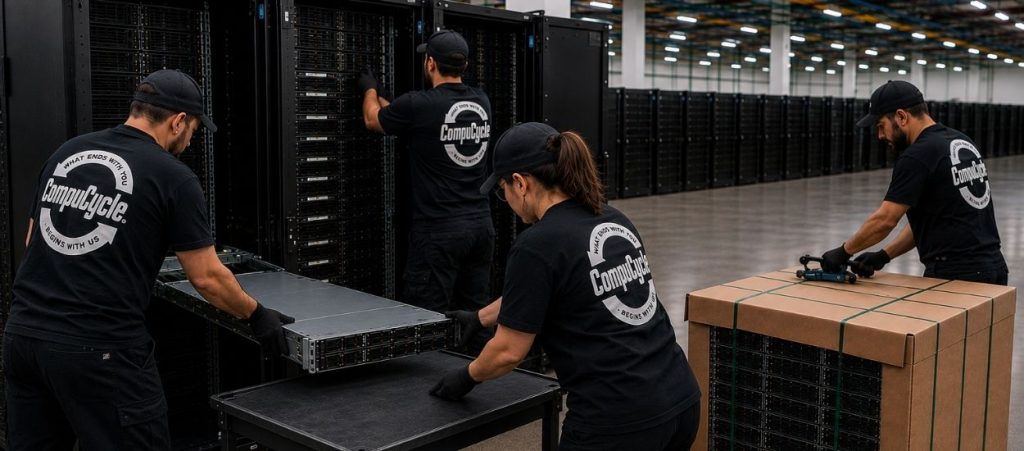
A Step-by-Step Look at Planning, On-Site Work, and Secure Asset Tracking and Transportation Whether you’re consolidating facilities, relocating to a colocation environment, upgrading infrastructure, or retiring an aging server room, a successful data center project…
The Domestic E-Plastics Crisis Nobody Is Talking About
The regulatory pressure on corporate sustainability has eased. That’s not a reason to stop doing the right thing. The Single-Use Problem Is Bigger Than Straws Every July, more than 170 million people in 190 countries…
ITAD Documentation That Actually Holds Up in an Audit
A Certificate of Destruction Is the Minimum. Here’s What Audit-Ready Documentation Looks Like. At the end of an ITAD project, most organizations receive a certificate of destruction and file it away. If an audit never…
Data Center Decommissioning Services: The Last Gap in Your Cybersecurity Plan
Does Your Incident Response Plan Cover What Happens After the Server Is Unplugged? Ask your CISO who owns decommissioning. Then ask your IT director. Then ask procurement. You’ll get three different answers — and that’s…
What to Expect During a Data Center Decommission or Relocation

The Domestic E-Plastics Crisis Nobody Is Talking About