
The regulatory pressure on corporate sustainability has eased. That’s not a reason to stop doing the right thing.
The Single-Use Problem Is Bigger Than Straws

Every July, more than 170 million people in 190 countries commit to refusing single-use plastics for a month. The Plastic Free July campaign, now in its fifteenth year, has driven real behavior change, with participants collectively avoiding over 1.7 million tonnes of plastic waste since 2011. Its central argument is simple and correct: something that takes up to a million years to decompose shouldn’t exist to hold your coffee for twelve minutes.
Nobody required those 170 million people to participate. No regulation mandated it. No ESG framework scored it. They did it because they decided it mattered.
But single-use is a design philosophy, not just a product category. It extends further than straws and packaging. Manufacturers recommend replacing laptops every one to three years. Most businesses refresh their hardware on a three-to-five-year cycle not because devices stop working, but because warranty coverage ends, security support lapses, and procurement cycles demand it. The plastics in those devices aren’t designed to break down on the same schedule. They’re engineered to last indefinitely.
We don’t call a corporate laptop single-use. But it has an industry-accepted decommissioning timeline decided before it was purchased. The material mismatch is identical to a plastic straw. Just slower, and orders of magnitude larger in volume.
ITAD Has a Plastics Problem the Industry Won’t Talk About
In 2022, the world generated 62 million tonnes of e-waste, a record. Inside that waste stream sat 17 million tonnes of plastics and 31 million tonnes of metals. The metals have a story with a relatively functional ending: gold, copper, silver, and iron carry recoverable economic value, so processors built the infrastructure to extract them. The plastics do not have that story.
E-waste is now rising five times faster than documented e-waste recycling. The global recycling rate sits at 22.3%, and under a business-as-usual scenario, the UN projects it will fall to 20% by 2030. The trajectory is moving in the wrong direction.
The consequence isn’t abstract. E-waste mismanagement releases an estimated 45 million kilograms of plastics containing brominated flame retardants into the environment every year. Those aren’t inert materials. Brominated flame retardants are associated with carcinogenicity, endocrine disruption, neurotoxicity, and reproductive toxicity. When processed at high temperatures without specialized equipment, they break down into dioxins and furans, among the most hazardous persistent pollutants known.
This is what is being released, at scale, annually, because the electronic waste recycling industry built the infrastructure to recover metals and largely stopped there.
Why Domestic E-Waste Recycling Avoids E-Plastics Processing
For years, the path of least resistance for e-plastics was export. Shredded or unsorted plastics from electronic equipment got shipped to markets with lower processing standards and lower labor costs, primarily China. It was cheaper than building domestic infrastructure. It moved the problem out of sight. And it counted, in some recycling rate calculations, as recycling.
Then in 2018, China banned most waste imports. The export stream scrambled for new destinations: Malaysia, Vietnam, India, Indonesia. Several of those countries have since tightened their own restrictions, compressing the export pathway further. What that compression exposed was a decision the U.S. industry had been deferring for decades: domestic mechanical recycling is underbuilt with no adequate domestic alternative waiting in the wings.
The specific chemistry of e-plastics is a large part of why. Between 30 and 50 percent of plastics used in electronic equipment contain halogenated flame retardants, required by safety standards, genuinely necessary, and genuinely difficult to process without specialized equipment and investment. Mixed plastic types in a single component complicate sorting. The capital commitment required to make domestic processing economically viable is one most recyclers haven’t made, because export was cheaper for as long as it was available.
Export is less available now. The domestic infrastructure still isn’t there. That’s the crisis.
CompuCycle’s Investment to Domestic E-Plastics Solutions
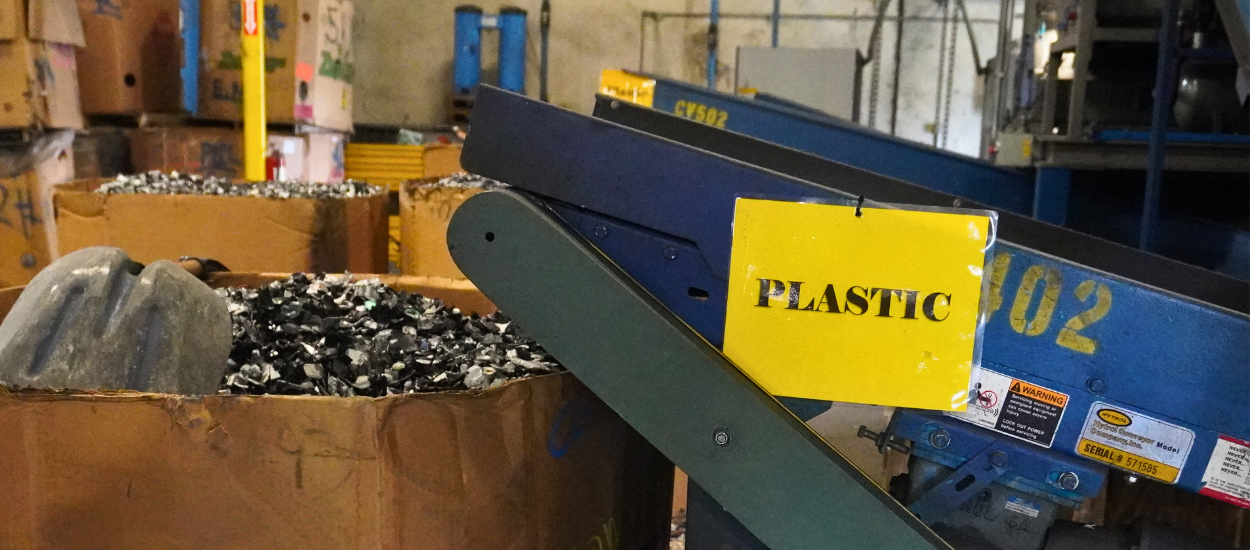
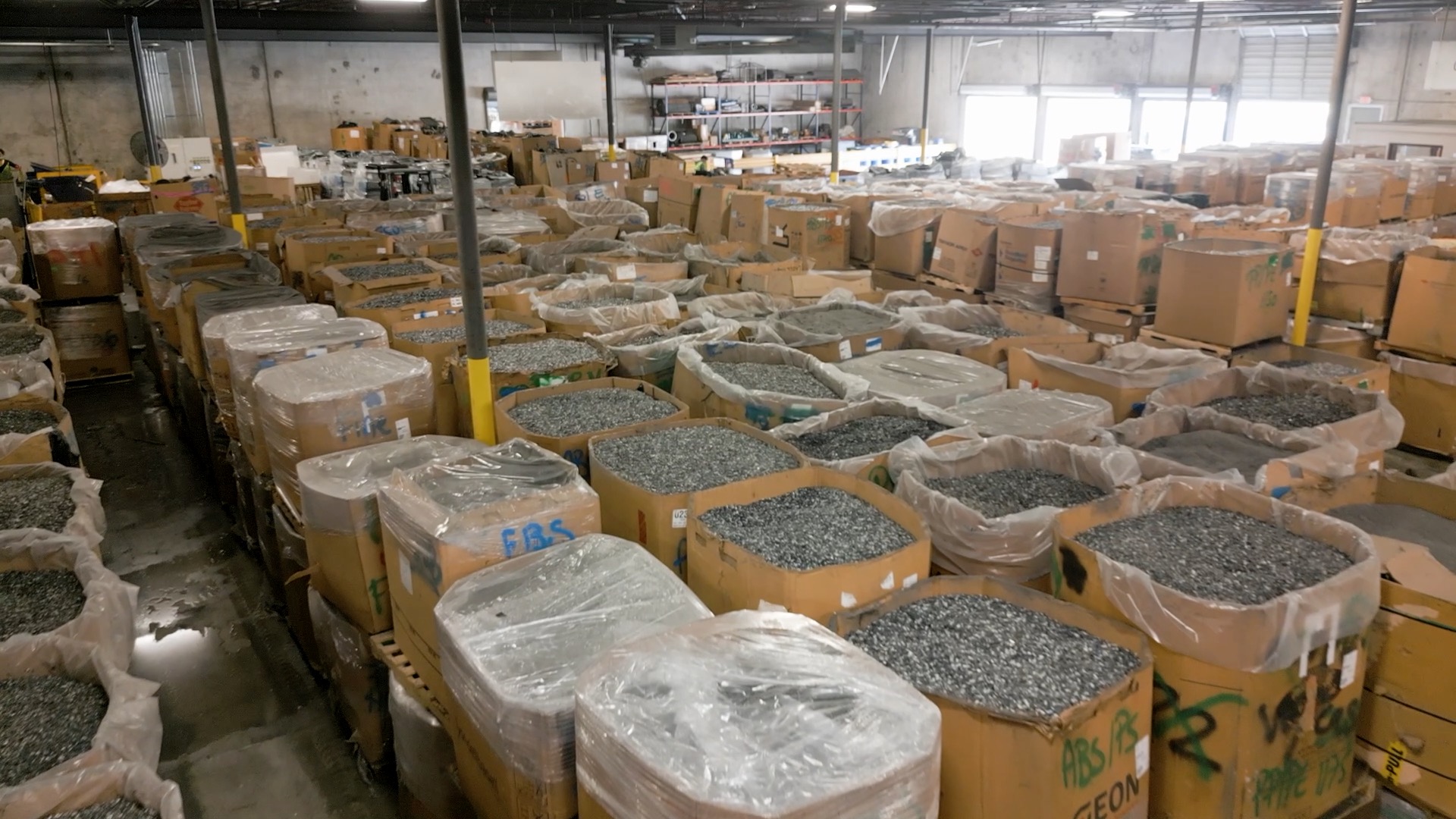
CompuCycle is the first and only e-waste recycler in the United States to offer fully in-house e-plastics processing. Where most processors stop at metals recovery, CompuCycle’s Houston facility takes the plastics through a complete domestic process: sorted, cleaned, and converted into single-polymer output ready for domestic reuse in manufacturing. No overseas shipment. No ambiguous downstream. A closed loop, built here, operated here, fully documented.
We didn’t build our e-plastics plant because regulation pushed us to. We built it because the problem is real, the materials are toxic, and we saw a way to help our local and national community instead of blaming industry standards.
See how our e-plastics processing works →
A Case for Corporate Sustainability When No One’s Requiring It
ESG reporting frameworks that once pushed large corporations to document and defend their environmental commitments are under pressure. Sustainability metrics that carried weight in investor scorecards and procurement evaluations a few years ago carry less weight today. Some of the most visible corporate sustainability programs have been quietly scaled back — not because the underlying environmental problems got smaller, but because the external pressure requiring those programs eased.
I understand the business logic. When sustainability efforts aren’t legally required and aren’t moving the needle on the bottom line, they become easy targets in a cost discipline conversation. That’s a rational response to changed conditions.
It’s also how 45 million kilograms of toxic plastics end up in the environment every year, according to the UN Global E-Waste Monitor.
The organizations I respect most, across industries including oil and gas, didn’t build environmental programs because a regulation or an investor mandate told them to. They built them because they operate in communities. Because their employees live near their facilities. Because the materials they handle don’t disappear when the reporting cycle ends.
Those programs didn’t get dismantled when the regulatory pressure softened. Because they were never really about the regulation.
Plastics Don’t Wait for Policy
Plastic Free July works because 170 million people decided the problem was worth solving. The e-plastics inside retired hardware are a bigger problem, a less visible one, and one that has a domestic solution available right now.
The regulatory pressure has eased. The plastics haven’t gone anywhere. What your organization does with its retired hardware is still an important decision with significant impact — it has just stopped being a required one.
The most direct action an organization can take is also the simplest: ask your ITAD vendor what happens to the plastics. If they can’t tell you where the plastics go and prove it, that’s worth knowing before you sign the contract.
Interested in learning more about the benefits of e-plastics recycling with CompuCycle? Request more information
Recent Articles
The Domestic E-Plastics Crisis Nobody Is Talking About
The regulatory pressure on corporate sustainability has eased. That’s not a reason to stop doing the right thing. The Single-Use Problem Is Bigger Than Straws Every July, more than 170 million people in 190 countries…
ITAD Documentation That Actually Holds Up in an Audit
A Certificate of Destruction Is the Minimum. Here’s What Audit-Ready Documentation Looks Like. At the end of an ITAD project, most organizations receive a certificate of destruction and file it away. If an audit never…
Data Center Decommissioning Services: The Last Gap in Your Cybersecurity Plan
Does Your Incident Response Plan Cover What Happens After the Server Is Unplugged? Ask your CISO who owns decommissioning. Then ask your IT director. Then ask procurement. You’ll get three different answers — and that’s…
CompuCycle and Pearland ISD Launch TechCycle: A Workforce Training Program Giving Students with Disabilities a Real Path to Employment
Innovative electronics recycling program trains 18–22 year old students with disabilities in real-world job skills — and is already changing lives. PEARLAND, TX — CompuCycle, a Houston-based IT Asset Disposition (ITAD) and electronics recycling company,…

The Domestic E-Plastics Crisis Nobody Is Talking About

ITAD Documentation That Actually Holds Up in an Audit