Corporate hard drives with recoverable data have been sold on eBay. Containers of e-waste have washed up on Malaysian shorelines and been traced back to U.S. companies. In every case, the liability didn’t fall on the vendor who mishandled the assets. It fell on the company whose name was still on the data.
These aren’t failures of rogue operators. They’re symptoms of how the ITAD industry actually works. The standard practice — even among certified vendors — is to collect assets and send them downstream to third-party processors for destruction and material recovery. It’s legal, it’s common, and it’s how the vast majority of ITAD companies operate.
At CompuCycle, we don’t think that’s good enough. Not for our clients, and not for the data they’re trusting us to destroy. So we built something different.
Where Does Corporate Liability Risk Actually Enter Your ITAD Program?
Even well-run ITAD programs can carry risks that are not obvious from the outside. The contracts look solid. The SLAs are in place. There’s a certificate of destruction at the end. But the distance between what’s documented and what’s actually happening is often wider than most companies realize.
Do Most ITAD Vendors Actually Process E-Waste Themselves?

Most don’t — and that’s not a secret the industry hides. It’s simply how the business is structured. The majority of ITAD vendors in the United States are logistics and brokerage operations. They pick up your equipment and send it to third-party processors for destruction and material recovery, sometimes through two or three intermediaries. It’s accepted practice. It’s how certified companies operate.
But every handoff in that chain is a point where your visibility ends and your exposure begins. Most clients never realize their assets are passing through multiple facilities and multiple sets of hands, because the paperwork that comes back looks the same either way.
CompuCycle exists because we believe corporations deserve to know exactly what happens to their assets — not just trust that someone in the chain of custody handled it.
What Happens When Data Destruction Is Outsourced?
When data destruction is outsourced — even by a reputable ITAD vendor — your vendor is issuing a certificate based on what they’ve been told happened, not what they witnessed or controlled. That certificate documents a report from a third party, not a verified outcome under your vendor’s roof.
Your drives are being handled by workers your vendor didn’t hire, in a facility your vendor may never have visited, under processes your vendor doesn’t manage day to day. This doesn’t make your vendor negligent. It makes them normal. But normal isn’t the same as secure.
For companies in regulated industries — healthcare, financial services, energy, government contracting — this matters more than most realize. Data handling obligations under HIPAA, GLBA, SOX, and state-level privacy regulations don’t end when hardware leaves your server room. The obligation to protect that data follows the data itself, regardless of how many vendors touch it along the way.
Does a Certificate of Destruction Actually Protect My Company?

A certificate of destruction is only as reliable as the process behind it. If your vendor collected your assets, shipped them to a downstream processor, and received confirmation that destruction occurred, that certificate reflects a chain of reports — not a chain of custody your vendor personally controlled.
Regulatory bodies and auditors are increasingly scrutinizing this difference. In the event of a data breach tied to improperly disposed assets, a certificate from a vendor who outsourced the actual destruction may not provide the legal protection most companies assume it does.
Can Improper ITAD Create Regulatory Risk for Your Organization?
Absolutely. When retired IT assets aren’t handled under a verified, controlled chain of custody, the regulatory exposure is real — and it extends well beyond data privacy. Environmental regulations like RCRA and international frameworks like the Basel Convention govern how electronic waste is transported and processed. Noncompliant disposal can trigger EPA enforcement actions, state-level penalties, and reputational damage that no compliance report can undo.
The risk isn’t limited to what’s on the hard drive. It’s in the entire lifecycle of the asset after it leaves your facility. If you can’t verify where it went and what happened to it at every stage, you have a gap in your compliance posture — whether you know it or not.
We Don’t Ask Clients to Trust What They Can’t See.

The industry standard works for most vendors. It doesn’t work for us. We built CompuCycle around a simple principle: if a client can’t verify what happened to their assets, then the process isn’t actually secure — it’s just convenient.
What Does Fully In-House ITAD Processing Look Like?

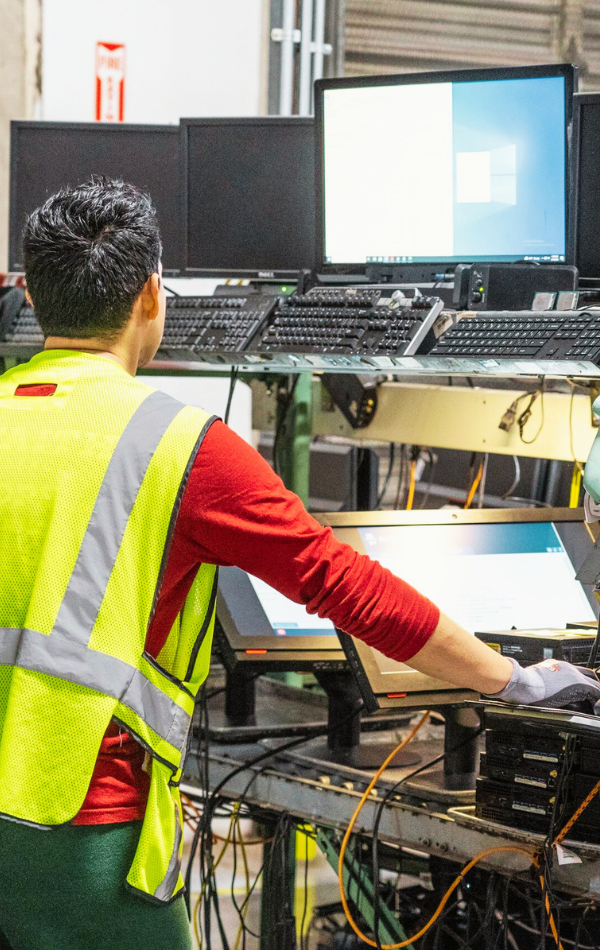
Everything — data destruction, electronics shredding, e-plastics processing, material recovery — happens at our secure 130,000 square foot facility in Houston, Texas. CompuCycle is one of the only ITAD providers in the country that processes everything in-house with zero downstream vendors. From the moment we pick up your assets to the moment materials are destroyed or recovered, the chain of custody has one link: us.
Every hard drive is serialized, tracked, and documented. Every process stage is audit-ready. Our facility is access-controlled with privacy fencing, wand metal detectors, background-checked staff, and a detailed visitor sign-in process. We don’t hand your assets to someone else and hope for the best. We handle them ourselves and prove it.
This isn’t about pointing fingers at the rest of the industry. It’s about choosing to operate at a standard that gives our clients something most ITAD programs can’t: complete visibility from pickup to final disposition.
What Certifications Reduce Regulatory Risk?
The certifications that matter most to enterprise buyers fall into three categories: data security, environmental compliance, and quality management. Most ITAD vendors carry one or two. CompuCycle holds nine — not because certifications alone are the answer, but because they represent a level of accountability we think every client deserves.
Data Security & Compliance
- ISO 27001 – Information Security Management
- NAID AAA – Data Destruction
- R2v3 – Responsible Recycling
- e-Stewards – Ethical E-Waste Management
Quality & Environmental
- ISO 9001 – Quality Management
- ISO 14001 – Environmental Management
- ISO 45001 – Health & Safety Management
In 2025, CompuCycle earned ISO 27001 certification — making us the only woman-owned e-waste processor in Texas with that information security credential. These aren’t badges on a website. They’re the audits your compliance, legal, and procurement teams are going to ask about during vendor review.

Why Do Companies Choose CompuCycle to Reduce Corporate Liability?
Because they’re looking for a risk-management partner, not just a recycler. Our clients come to us because they’ve looked under the hood of the standard ITAD model and decided they need something more accountable. They need to know exactly what happens to every asset, at every stage, with documentation that can withstand an audit — not just satisfy a checklist.
That’s what a single-facility, zero-downstream model gives them. Complete control. Complete visibility. No room for assumptions. Our partners view us as an extension of their own risk management, because that’s exactly what we are.
Circularity Isn’t a Marketing Word. It’s a Risk Reduction Strategy.
There’s a growing conversation in boardrooms about circularity, sustainability, and responsible disposal. These are important goals — and we take them seriously. But too often, “circularity” gets applied as a label to programs where materials disappear into opaque downstream channels and no one can say exactly where they ended up. That’s not circularity. That’s hope.
What Does Real Circularity Look Like in ITAD
Circularity only works when reuse, destruction, and material recovery are all transparent and controlled. At CompuCycle, our approach follows a clear hierarchy: reuse first, controlled destruction when reuse isn’t viable, and responsible material recovery for everything else.
When assets arrive at our facility, we assess every piece of equipment for refurbishment and remarketing potential. Hardware that still has functional life gets a second one — securely wiped, tested, and made available for resale. This isn’t just an environmental win. It’s a value recovery opportunity for our clients, returning revenue from assets that would otherwise be written off entirely.
When equipment has reached true end of life, our in-house shredding and processing lines break it down into separated raw materials — steel, copper, aluminum, circuit boards, and plastics. We’re the only electronics recycler in the United States that processes e-plastics down to single polymers for domestic reuse by OEMs. The plastic housings from your retired laptops and servers don’t end up in a landfill or on a container ship. They go back into American manufacturing as raw material.
Sustainability isn’t a slogan for us. Shredding isn’t strategy. Reuse comes first. We control the process. And when materials are recovered, we know exactly where they go — because they never left our facility until they were ready.
Your Brand Is Only as Secure as Your ITAD Partner.
The ITAD industry operates the way it operates for understandable reasons — scale, cost efficiency, logistics. We’re not here to say the entire industry is broken. We’re here to say that for companies whose data, compliance obligations, and brand reputation are on the line, the standard approach leaves gaps that don’t have to exist.
The companies that get this right aren’t the ones who found the cheapest pickup service. They’re the ones who asked harder questions: Who actually destroys our drives? Where does our equipment physically go? Can we verify every step, or are we relying on someone else’s word?
CompuCycle was built to answer every one of those questions with complete transparency. One facility. One chain of custody. Certified data destruction. Documented at every stage. Audit-ready from day one.
For over 30 years, we’ve helped companies close the gap between what they assume is happening with their retired IT assets and what’s actually provable. No outsourced destruction. No opaque downstreams. No distance between what we promise and what we can show you.
So you can sleep at night.

Ready to see the difference for yourself? Contact us for a corporate quote or schedule a tour of our facility to see exactly how CompuCycle protects your data and your brand.
Recent Articles
ITAD Isn’t a Recycling Decision. It’s a Risk Reduction & Brand Protection Decision.
Corporate hard drives with recoverable data have been sold on eBay. Containers of e-waste have washed up on Malaysian shorelines and been traced back to U.S. companies. In every case, the liability didn’t fall on…
The $987 Billion Question: Is Your ITAD Partner Ready for AI’s Hardware Avalanche?
The data center industry is experiencing an infrastructure transformation unlike anything since the advent of the internet era. While headlines focus on the trillions being poured into AI infrastructure, a critical downstream challenge is emerging…
Goodwill Houston Partners with CompuCycle to Offer Simple E-Waste Recycling for the Community
Goodwill Houston and CompuCycle have partnered to give Houstonians a simple, trustworthy way to donate and recycle household electronics.
Through this collaboration, residents can drop off laptops, desktops, tablets, monitors, and other household electronics at participating Goodwill Greater Houston donation centers. Reusable items help fund Goodwill’s job training and community programs, while non-resellable electronics are sent directly to CompuCycle’s certified Houston facility for secure, fully in-house recycling—ensuring materials are responsibly processed locally from start to finish.
CompuCycle Becomes Exclusive Woman-Owned E-Waste Processor in Texas with ISO 27001 Data Security Certification
New Information Security Management System (ISMS) Certification Guarantees End-to-End Data Confidentiality and Integrity for Corporate IT Asset Disposition (ITAD). HOUSTON, TX – December 9, 2025 – CompuCycle, an industry leader in secure and sustainable IT…

ITAD Isn’t a Recycling Decision. It’s a Risk Reduction & Brand Protection Decision.

The $987 Billion Question: Is Your ITAD Partner Ready for AI’s Hardware Avalanche?