
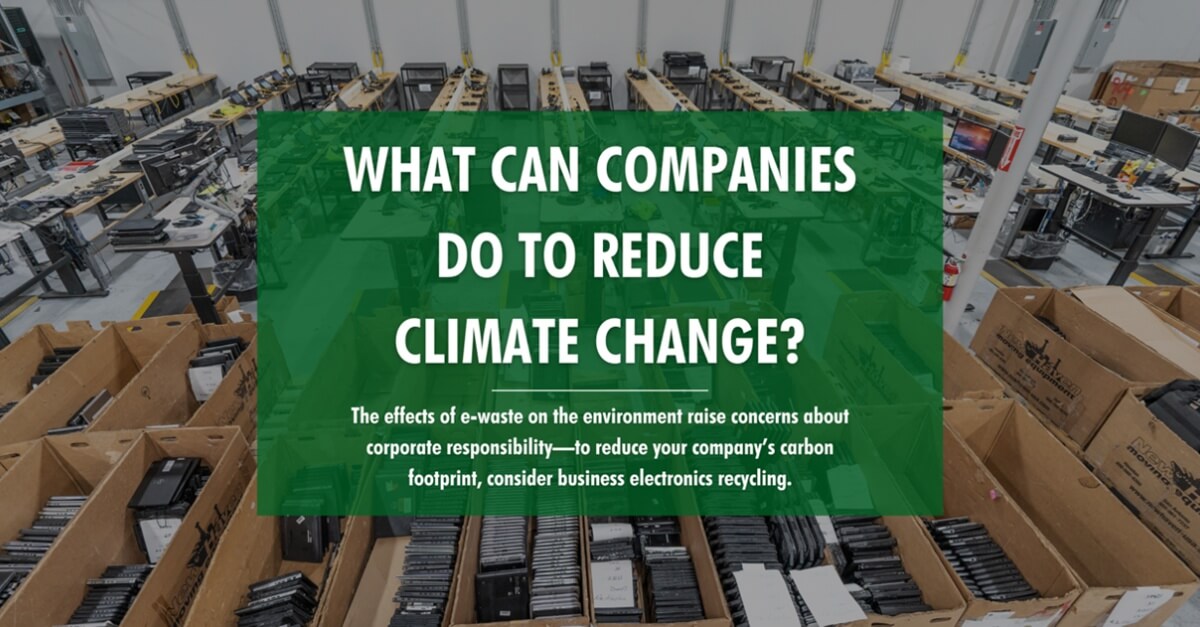
The 21st century is the age of digitization—meaning technology is vital to all types of business, big or small. But technology has an expiration date, requiring companies to update their IT assets with newer systems.

If you’ve been wondering, “What can companies do to reduce climate change?” read on. The effects of e-waste on the environment raise concerns about corporate responsibility—to reduce your company’s carbon footprint, consider business electronics recycling.
Corporate Impact
The public dialogue regarding climate change turns the blame onto individuals, giving suggestions on personal sustainable hacks that can make a difference. While individuals should properly recycle their electronics, corporations are being conveniently forgotten when it comes to the levels of greenhouse gas emissions that are negatively affecting the planet.
According to the Carbon Majors Report, 71% of global emissions since 1988 can be attributed to only 100 companies. Nearly three-quarters of emissions are produced by corporations, many of which are oil and gas companies. And this isn’t even accounting for the e-waste produced.
Effects of E-Waste on the Environment
E-waste touches every aspect of our environment. It affects the air we breathe, the water we drink, the plants we harvest, the nature we enjoy… and so on. Many components that make up our technology are toxic when improperly disposed of. Lead, mercury, zinc, nickel, barium, and chromium are some examples of abundant toxins from e-waste.
When electronic waste is illegally dumped into landfills or disposed of by combustion, these toxins are dispersed into our air, oceans, and soil. Not only does this affect human health by contributing to the risk of cancers and respiratory diseases, but it also affects entire ecosystems. Plant and animal biodiversity is diminishing at a rapid rate due to e-waste interference.
The effects of e-waste on the environment are only increasing, but there is an easy way to prevent this from worsening: business electronics recycling.
Business Electronics Recycling
While the 21st century comes with various pain points regarding the digital revolution’s effects, it also comes with innovative solutions. E-waste is a part of our culture, but the disposal of it is what matters.
Proper disposal looks like this: all assets are decommissioned and sanitized to avoid data breaches; they are then either refurbished or recycled depending on the quality of the materials; the recycled assets are shredded and separated into their raw materials; these are then sent to refineries and smelters to be processed and used again.
CompuCycle makes this process as easy as possible for corporate IT departments. We provide onsite inventory and pickup of your materials, requiring little disruption to your operations. The best part is this actually saves companies money! We give you your money back for any materials that can be resold.
To prove how CompuCycle’s services improve your company’s impact on the environment, we provide our clients with an environmental scorecard. This document outlines how many pounds of assets were diverted from the landfill through our recycling and refurbishing efforts. Company sustainability departments can utilize the scorecard to better position their business to both stakeholders and clientele.
We Make Your Business Better
Utilizing CompuCycle’s services will improve your company in many ways. Corporations are being held accountable for their impact on the environment, and we provide a seamless solution to prove your efforts in sustainability.
If asked, “What can companies do to reduce climate change?” you now have an answer: business electronics recycling! To learn more about how CompuCycle can aid in your carbon footprint reduction, contact us! We look forward to providing a tailored solution for your end-of-life IT assets.
Recent Articles
Tech Recycle: Turning Recycled Electronics Into Paid Workforce Training for Students
12-week paid program · Ages 18-22 · Certified, Secure Recycling with Value Back · Zero cost to participate For transition-age youth, preparing for life after school often requires more than classroom instruction. Students need opportunities…
What to Expect During a Data Center Decommission or Relocation
A Step-by-Step Look at Planning, On-Site Work, and Secure Asset Tracking and Transportation Whether you’re consolidating facilities, relocating to a colocation environment, upgrading infrastructure, or retiring an aging server room, a successful data center project…
The Domestic E-Plastics Crisis Nobody Is Talking About
The regulatory pressure on corporate sustainability has eased. That’s not a reason to stop doing the right thing. The Single-Use Problem Is Bigger Than Straws Every July, more than 170 million people in 190 countries…
ITAD Documentation That Actually Holds Up in an Audit
A Certificate of Destruction Is the Minimum. Here’s What Audit-Ready Documentation Looks Like. At the end of an ITAD project, most organizations receive a certificate of destruction and file it away. If an audit never…
ITAD Documentation That Actually Holds Up in an Audit

Data Center Decommissioning Services: The Last Gap in Your Cybersecurity Plan
What R2 Certification Means When Buying Wholesale IT Equipment
- « Previous
- 1
- 2
- 3
- Next »